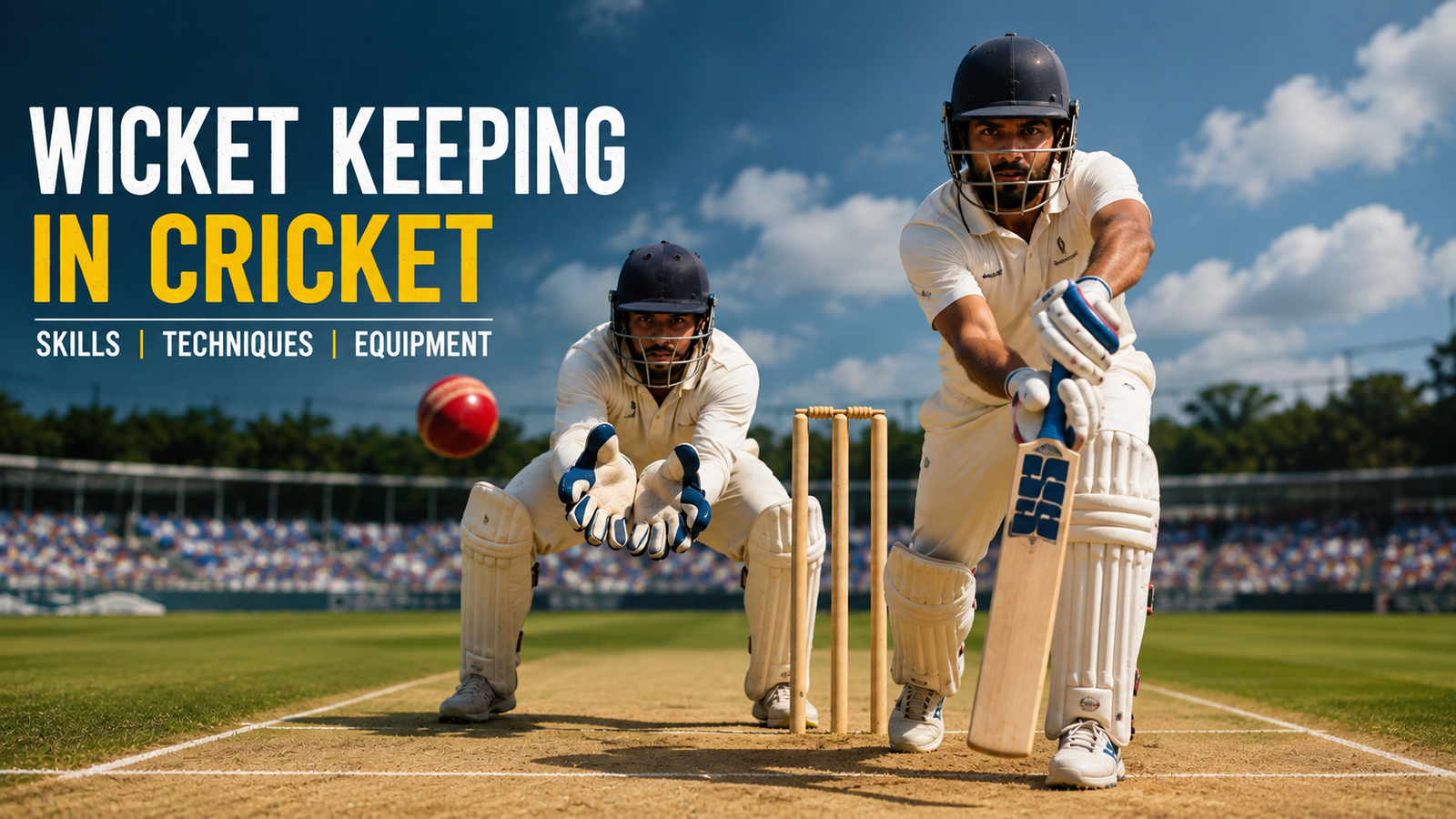
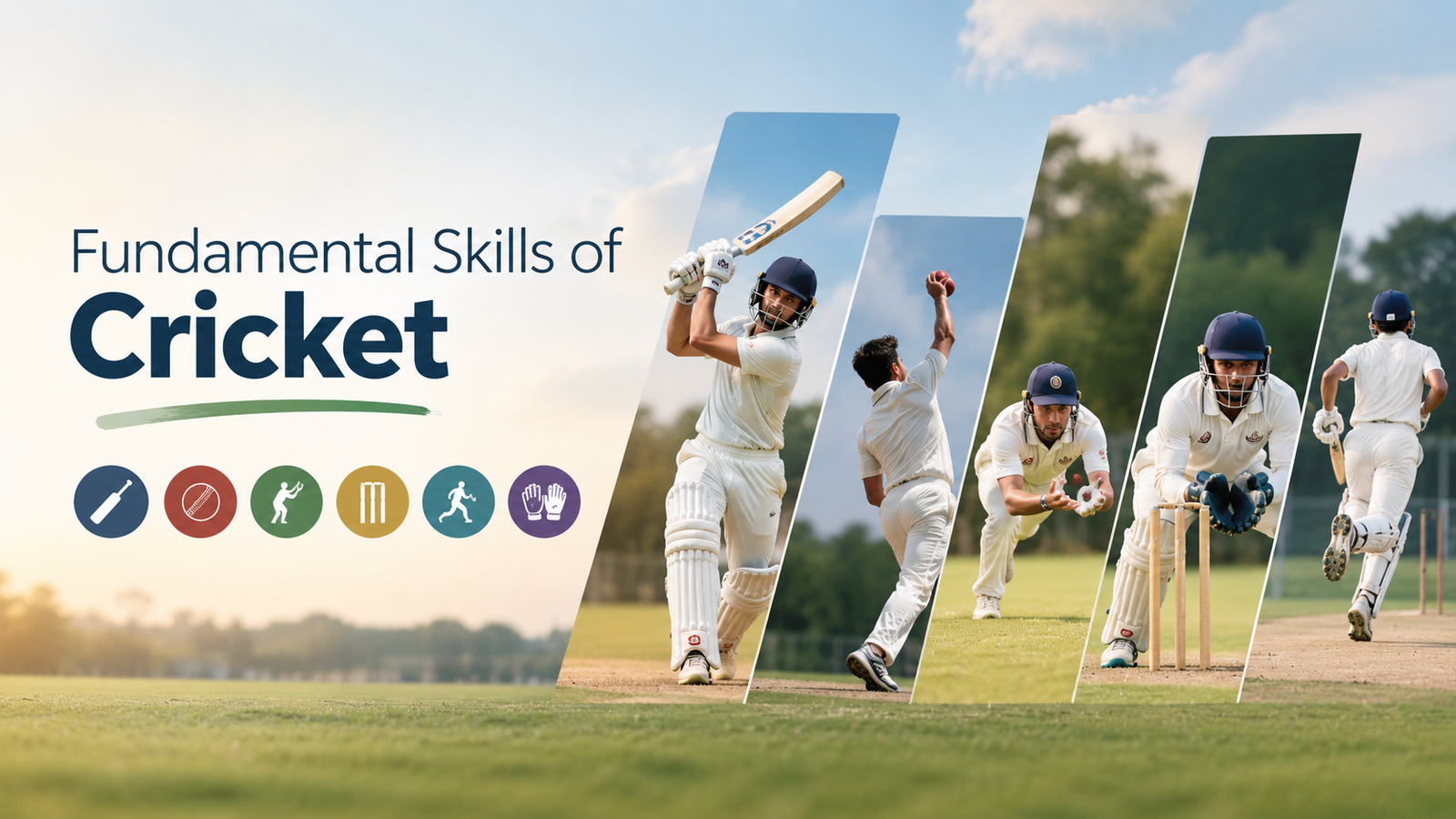
Cricket is changing quickly. With T20 leagues, shorter formats, advanced analytics, and faster match situations becoming increasingly important, players are expected to do more than simply bat or bowl well. Yet, despite all these developments, strong performances still begin with the fundamental skills of cricket.
Whether you are a beginner learning the game, a junior player developing technique, or an aspiring competitive cricketer, mastering the basics creates a foundation for long-term improvement. The core areas remain batting, bowling, fielding, wicketkeeping, and running between the wickets, but modern training also places greater emphasis on decision-making, agility, and adaptability.
Why Fundamental Cricket Skills Still Matter
Modern cricket may feature innovative shots, variations, data analysis, and specialist roles, but these advanced abilities depend on strong fundamentals.
The International Cricket Council’s coaching resources continue to introduce beginners to the basic disciplines of batting, bowling, and fielding before progressing toward more advanced cricket development.
A player with reliable fundamentals can adapt more easily to different formats and match situations. Good balance, hand-eye coordination, timing, accuracy, movement, and awareness are useful whether a player is facing a fast bowler in a T20 match or building a long innings in a longer format.
1. Batting: Build Control Before Power
Batting is often associated with big sixes and aggressive stroke play, particularly in modern T20 cricket. However, powerful hitting becomes more effective when it is supported by sound technique.
The key batting fundamentals include:
- Correct grip
- Balanced stance
- Head position and balance
- Controlled backlift
- Footwork
- Watching the ball closely
- Shot selection
- Timing and placement
The ICC describes batting as much more than simply hitting the ball, with technique, grip, tactics, and other skills playing important roles.
Beginners should first learn to defend, drive, rotate the strike, and play the ball according to its line and length. Once these skills become consistent, players can gradually develop attacking shots such as pulls, cuts, sweeps, lofted drives, and innovative T20 strokes.
2. Bowling: Accuracy Comes Before Speed
Fast bowling can look spectacular, but speed alone does not make an effective bowler. A strong bowling foundation involves grip, run-up, balance, body alignment, release, and consistent line and length.
Players should initially focus on delivering the ball accurately to a target. Once control improves, they can work on variations such as swing, seam movement, slower balls, cutters, or spin.
The ICC’s bowling resources cover fast, swing, seam, and spin bowling, highlighting the different technical skills required across bowling styles.
A useful modern approach is to train bowlers to understand why a delivery is being bowled rather than simply repeating the same action. Reading the batter, pitch conditions, field placement, and match situation can help turn basic bowling technique into effective match skills.
3. Fielding: The Skill That Can Change a Match
Fielding has become increasingly important in limited-overs cricket. A sharp catch, quick pickup, or accurate throw can save runs and create pressure.
The basic fielding skills include:
- Ground fielding
- Catching
- Throwing
- Stopping boundaries
- Quick movement
- Reaction speed
- Anticipation
Good fielding starts with body position and awareness. Players should remain balanced, keep their eyes on the ball, and move quickly toward it. Cricket coaching resources also emphasize catching and throwing as essential foundational skills.
For developing players, simple catching and ground-fielding drills performed consistently can be more useful than attempting difficult highlight-reel catches too early.
4. Running Between the Wickets: Turn Singles Into Pressure
Running between the wickets is one of the most underestimated fundamental skills of cricket.
Modern limited-overs cricket is heavily influenced by strike rotation. Players who can convert singles into twos, communicate clearly, and respond quickly after playing a shot can keep the scoreboard moving without depending entirely on boundaries.
Important skills include:
- Clear calling
- Quick first steps
- Backing up
- Safe turning
- Bat grounding
- Understanding when to run
- Reading the field
Good running is not only about speed. It also involves communication, awareness, timing, and decision-making.
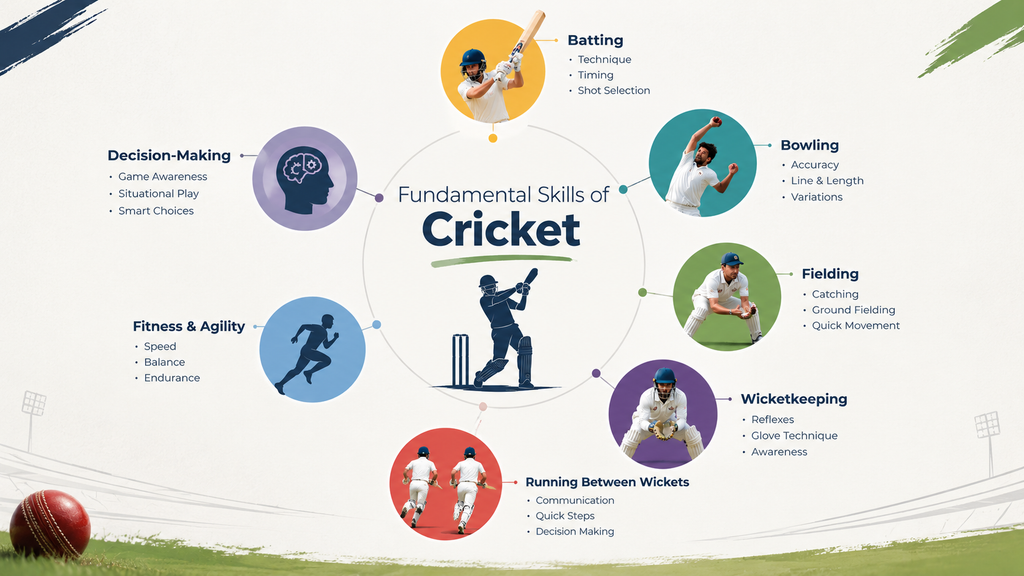
5. Wicketkeeping: Technique, Reflexes and Awareness
Wicketkeeping requires a combination of technical skill, concentration, agility, and anticipation.
A wicketkeeper needs to develop:
- Correct crouching position
- Glove technique
- Foot movement
- Ball tracking
- Catching behind the stumps
- Collecting deliveries cleanly
- Quick movement toward the stumps
- Awareness of run-out opportunities
Because the wicketkeeper is involved in almost every delivery, consistent concentration is just as important as physical technique.
6. Cricket Fitness and Agility
Skill development cannot be separated from physical preparation. Players need mobility, coordination, speed, balance, and endurance to perform their skills effectively.
Modern cricket training increasingly combines technical practice with movement-based drills. Short sprints, reaction exercises, agility work, catching drills, and cricket-specific movement can help players become more efficient on the field.
The goal is not simply to become fitter. It is to develop fitness that supports cricket-specific movements and repeated match situations.
7. Decision-Making: The Modern Cricket Fundamental
One of the biggest differences between simply knowing a skill and using it effectively is decision-making.
A batter must decide whether to attack or defend. A bowler must select the right delivery. A fielder must judge whether to attack the ball or protect the boundary.
This is why practice should include realistic match situations rather than only repetitive drills. The ICC’s coaching pathway also progresses from foundational knowledge toward more advanced technical and practical coaching development.
For players looking to understand more about structured cricket development, ICC Training & Education resources provide information on coaching pathways and foundational cricket education.
How to Improve the Fundamental Skills of Cricket
Improvement does not always require complicated training. Players can follow a simple progression:
Learn → Practise → Repeat → Apply → Review
Start with one technical skill, practise it correctly, introduce pressure or movement, and then apply it in a realistic match situation.
For example, a batter can progress from basic defensive shots to target-based stroke play and eventually to scenario-based practice such as chasing a specific number of runs.
The same principle applies to bowling, fielding, wicketkeeping, and running between the wickets.
Conclusion
The modern game may be faster and more innovative than ever, but strong players still depend on the fundamental skills of cricket. Batting technique, bowling accuracy, sharp fielding, wicketkeeping, running between the wickets, fitness, and decision-making provide the foundation for developing a complete cricketer.
For players who want to build these abilities systematically, Arjun Gupta focuses on cricket development with an emphasis on strengthening the skills that matter from the basics to competitive performance.
FAQs
1. What are the fundamental skills of cricket?
The main fundamental skills of cricket include batting, bowling, fielding, wicketkeeping, and running between the wickets. Fitness, coordination, and decision-making also support overall development.
2. Why are cricket fundamentals important?
Strong fundamentals help players develop consistent technique, make better decisions, and adapt to different match situations and formats.
3. Which cricket skill should beginners learn first?
Beginners should build basic batting, bowling, catching, throwing, movement, and running skills rather than focusing immediately on advanced techniques.
4. How can I improve my cricket skills?
Regular practice, structured drills, match-situation training, fitness work, and feedback from a qualified coach can help improve cricket skills over time.
5. Are fundamental cricket skills useful in T20 cricket?
Yes. T20 cricket requires fast decision-making and execution, but skills such as batting control, bowling accuracy, fielding, catching, and running between wickets remain essential.